

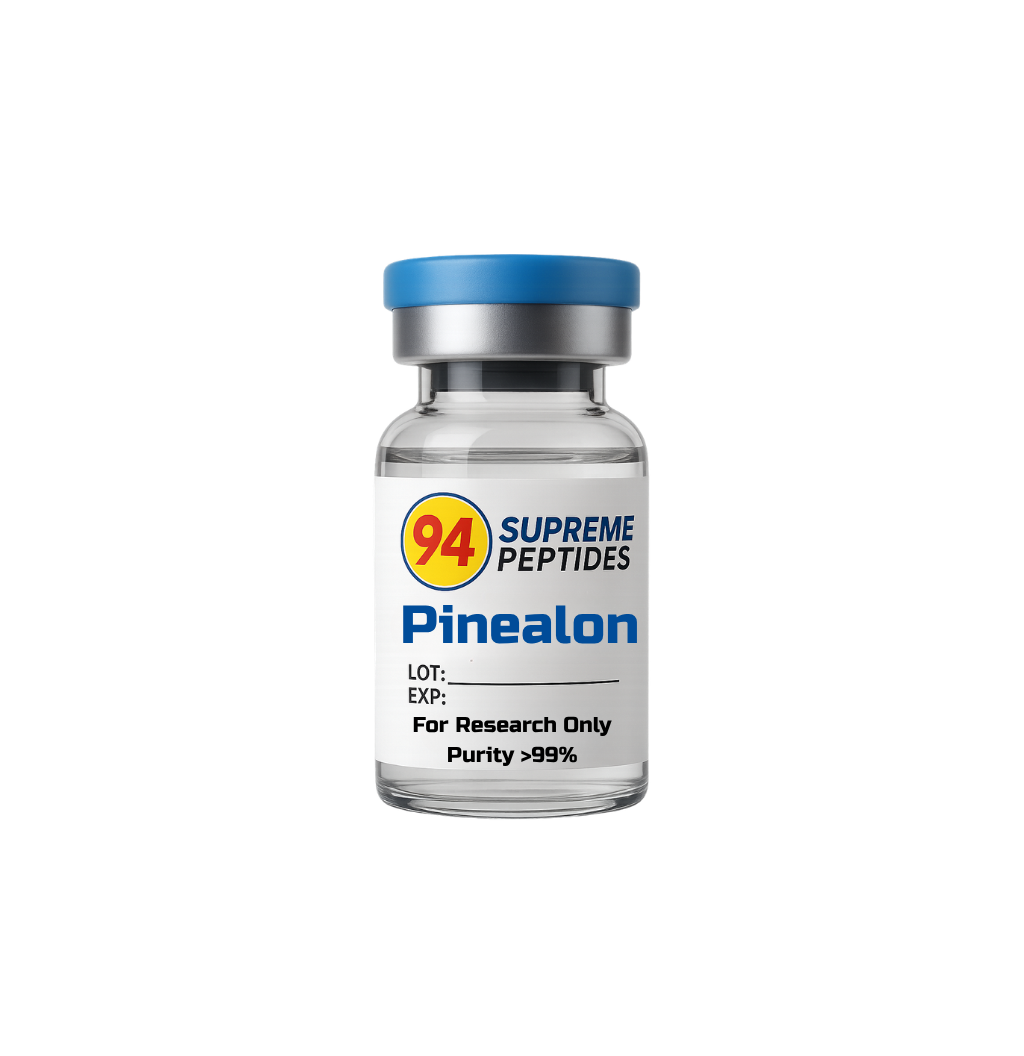
Pinealon
Research use only.
Pinealon is a very short peptide from a family of Russian research compounds known as bioregulators. It is studied for its possible effects on the brain and nervous system.
What it is studied for
- Brain function: memory, focus and mental sharpness in research models.
- Cell protection: nerve cell responses to stress in research models.
- Healthy ageing: part of research into age-related decline.
What is Pinealon?
Pinealon is a synthetic tripeptide made of glutamic acid, aspartic acid and arginine (Glu-Asp-Arg, or EDR). It belongs to the short bioregulator peptides developed at the St. Petersburg Institute of Bioregulation and Gerontology. In cell and animal studies it is examined for antioxidant and neuroprotective effects. It is sold here for laboratory research only.
Glu-Asp-ArgQuestions researchers ask
What is Pinealon studied for?
Pinealon is studied mainly in neuroprotection models. Cell studies report that it limits reactive oxygen species build-up and necrotic cell death in cerebellar neurons and PC12 cells under oxidative stress. Rat studies have examined offspring exposed to prenatal hyperhomocysteinemia, and computational work has explored its interaction with DNA and gene expression.
Pinealon vs Epitalon: what is the difference?
Both are short synthetic bioregulator peptides from the same St. Petersburg research school. Pinealon is a tripeptide (Glu-Asp-Arg) studied mostly for brain cell protection. Epitalon is a tetrapeptide (Ala-Glu-Asp-Gly) based on a pineal gland extract and studied mainly for telomerase activity, melatonin and ageing. They are different molecules with different research focuses.
How does Pinealon work?
The mechanism is still under study. Published cell work shows antioxidant activity and delayed ERK 1/2 activation, plus changes in the cell cycle at higher concentrations. Because it is very small, researchers propose it can enter the nucleus and interact directly with DNA to influence gene expression, but that hypothesis rests largely on modelling.
Is Pinealon a peptide?
Yes. Pinealon is a tripeptide, the shortest kind of peptide after a dipeptide, made of three amino acids joined by peptide bonds: L-glutamic acid, L-aspartic acid and L-arginine. Its molecular formula is C15H26N6O8 and its molecular weight is about 418.4 g/mol, according to PubChem.
Is Pinealon legal in Canada?
In Canada, Pinealon is sold as a research chemical for laboratory use. It is not authorized by Health Canada as a drug for human use, so it cannot be sold for human consumption. Researchers should keep purchase records and the batch Certificate of Analysis with their laboratory documentation.
Published research 2 peer-reviewed papers
Chemical data verified against a public reference database.
Reviewed by the 94 Supreme Peptides team · For laboratory research use only. Not for human or veterinary use.
About Pinealon
Pinealon is a three-amino-acid peptide (Glu-Asp-Arg, often written EDR) from the family of short "bioregulator" peptides developed by Vladimir Khavinson and colleagues. Because it is so small, it has been studied for effects inside the cell, and most published work looks at neuroprotection and brain ageing in cell and animal models.
Key research areas
- Neuroprotection research — Protection of nerve cells exposed to oxidative stress in cell-culture models.
- Brain-ageing models — Markers of neuronal function and survival in ageing animal models.
- Cellular-stress studies — Reactive oxygen species, cell viability and stress-response signalling.
- Short-peptide gene regulation — The hypothesis that very short peptides can influence gene expression.
Specifications
| Sequence | H-Glu-Asp-Arg-OH (EDR) |
| Molecular formula | C15H26N6O8 |
| Molecular weight | approx. 418.4 g/mol |
| Form | Lyophilized powder |
| Purity | HPLC-tested, per-batch certificate of analysis |
| Storage | Sealed vial cold and away from light; refrigerate once reconstituted |
Frequently asked questions
What is Pinealon?
A synthetic tripeptide made of glutamic acid, aspartic acid and arginine, studied mainly in neuroprotection and brain-ageing research models.
How is Pinealon different from Epithalon?
Both are short bioregulator peptides from the same research group. Epithalon is a four-amino-acid peptide (AEDG) studied mostly in ageing and telomere research, while Pinealon (EDR) is studied mostly in nerve-cell models.
Does it come with a COA?
Every batch is HPLC-tested. The certificate for each size is linked on this page and listed in the COA library.
Is Pinealon for human use?
No. It is sold strictly for laboratory research use only.
Related research compounds
For laboratory research use only. Not for human or veterinary consumption.
Guides about Pinealon
Related products
Customer reviews
Be the first to review this research peptide and help other researchers.
All products are sold strictly for laboratory and research use only — not for human or veterinary use, consumption, or therapeutic application. By purchasing you confirm you are a qualified researcher and accept full responsibility for safe handling and compliance with applicable laws.