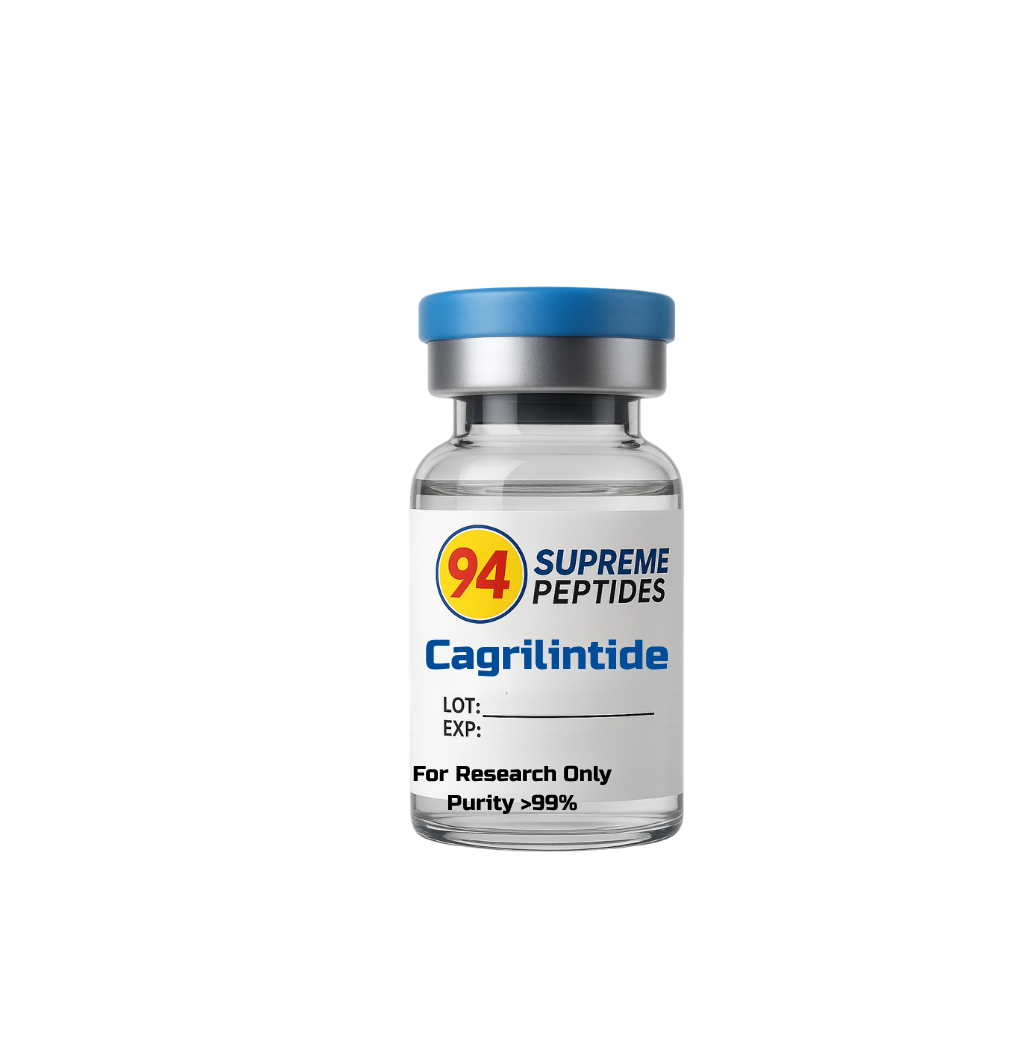
Cagrilintide
Research use only.
Cagrilintide comes from a different family than the popular GLP-1 compounds. It is a long-acting version of amylin — a natural hormone that works alongside insulin to signal fullness and slow how quickly the stomach empties. Because it works through a separate pathway, researchers are especially interested in how it behaves on its own and when paired with a GLP-1 peptide.
What it is studied for
- Appetite: the role of the amylin pathway in hunger signals.
- Weight management: both on its own and combined with GLP-1 peptides.
- Fullness signals: how it affects feeling satisfied after eating.
How it works (in plain terms)
Most of the well-known metabolic peptides copy GLP-1. Cagrilintide instead copies amylin, a different "I am full" hormone. Using a separate lever is why it is often studied together with a GLP-1 peptide — the idea being that two different signals may add up.
The semaglutide pairing
A lot of the research interest in cagrilintide comes from pairing it with semaglutide (a combination studied in trials as "CagriSema"). It is a clear example of how researchers combine an amylin peptide with a GLP-1 peptide to compare their effects side by side.
Storing and mixing it (for lab use)
Cagrilintide ships as a freeze-dried powder. Sealed, cold and out of the light, it stays stable for a long time. For research it is mixed (reconstituted) with bacteriostatic water, then kept refrigerated. Our on-site peptide calculator can help with mixing amounts.
What you get from us
Every batch is HPLC-tested with its own Certificate of Analysis (COA), so you can confirm identity and purity first. We ship across Canada, usually within 1–3 business days by Xpresspost.
Common questions
How is cagrilintide different from semaglutide? Semaglutide copies GLP-1; cagrilintide copies amylin. They are two different fullness pathways, which is why they are often studied together.
Is it an approved medicine? No. We supply it strictly as a research compound — not for human or animal use.
Do you include a COA? Yes — every batch has its own Certificate of Analysis you can view before buying.
Do you ship to me? We ship within Canada only.
Research use only. Not for human or veterinary use. Nothing here is medical advice.
What is Cagrilintide?
Cagrilintide is a synthetic, long-acting analogue of amylin, a hormone released alongside insulin from pancreatic beta cells that signals fullness to the brain. A fatty-acid chain extends its duration of action. Researchers use it to study amylin receptor signalling and satiety, alone or combined with GLP-1 agonists such as semaglutide.
Lys-Cys-Asn-Thr-Ala-Thr-Cys-Ala-Thr-Gln-Arg-Leu-Ala-Glu-Phe-Leu-Arg-His-Ser-Ser-Asn-Asn-Phe-Gly-Pro-Ile-Leu-Pro-Pro-Thr-Asn-Val-Gly-Ser-Asn-Thr-Pro-NH2 (N-terminal C20 diacid-γGlu; Cys2-Cys7 disulfide)
Questions researchers ask
Is cagrilintide a GLP-1?
No. Cagrilintide is an amylin analogue, not a GLP-1 receptor agonist. It acts on amylin and calcitonin-family receptors, mainly in the brain regions that regulate satiety. This different mechanism is the reason researchers study it alongside GLP-1 agonists, since the two pathways appear to have additive effects on appetite signalling.
Cagrilintide vs semaglutide: what is the difference?
Semaglutide mimics GLP-1, a gut hormone that stimulates insulin release and slows gastric emptying. Cagrilintide mimics amylin, a pancreatic hormone that promotes satiety through separate brain pathways. Both are fatty-acid-modified peptides designed for weekly exposure. In a 2021 Phase 2 trial, cagrilintide was compared against liraglutide, an earlier GLP-1 agonist.
What is CagriSema?
CagriSema is Novo Nordisk's investigational combination of cagrilintide and semaglutide given together. It has been tested in the REDEFINE Phase 3 clinical trial programme, with results published in the New England Journal of Medicine in 2025. It is not the product sold here; this page offers cagrilintide alone for laboratory research.
How does cagrilintide work?
Cagrilintide binds amylin receptors, which are calcitonin receptors paired with receptor activity-modifying proteins. In research models, amylin signalling acts on homeostatic and hedonic brain regions involved in satiety. Its fatty-acid side chain promotes albumin binding, extending its duration of action far beyond that of native amylin or the older analogue pramlintide.
Is cagrilintide approved in Canada?
No. Cagrilintide is an investigational compound and is not authorized by Health Canada as a drug, either alone or as CagriSema. In Canada it is sold as a research chemical for laboratory use only and cannot be sold for human consumption. This is general information, not legal advice.
Published research 3 peer-reviewed papers
Chemical data verified against a public reference database.
Reviewed by the 94 Supreme Peptides team · For laboratory research use only. Not for human or veterinary use.
Guides about Cagrilintide
Related products
Customer reviews
Be the first to review this research peptide and help other researchers.
All products are sold strictly for laboratory and research use only — not for human or veterinary use, consumption, or therapeutic application. By purchasing you confirm you are a qualified researcher and accept full responsibility for safe handling and compliance with applicable laws.