

Are Peptides Steroids? How the Two Molecule Classes Differ in Chemistry and Canadian Law
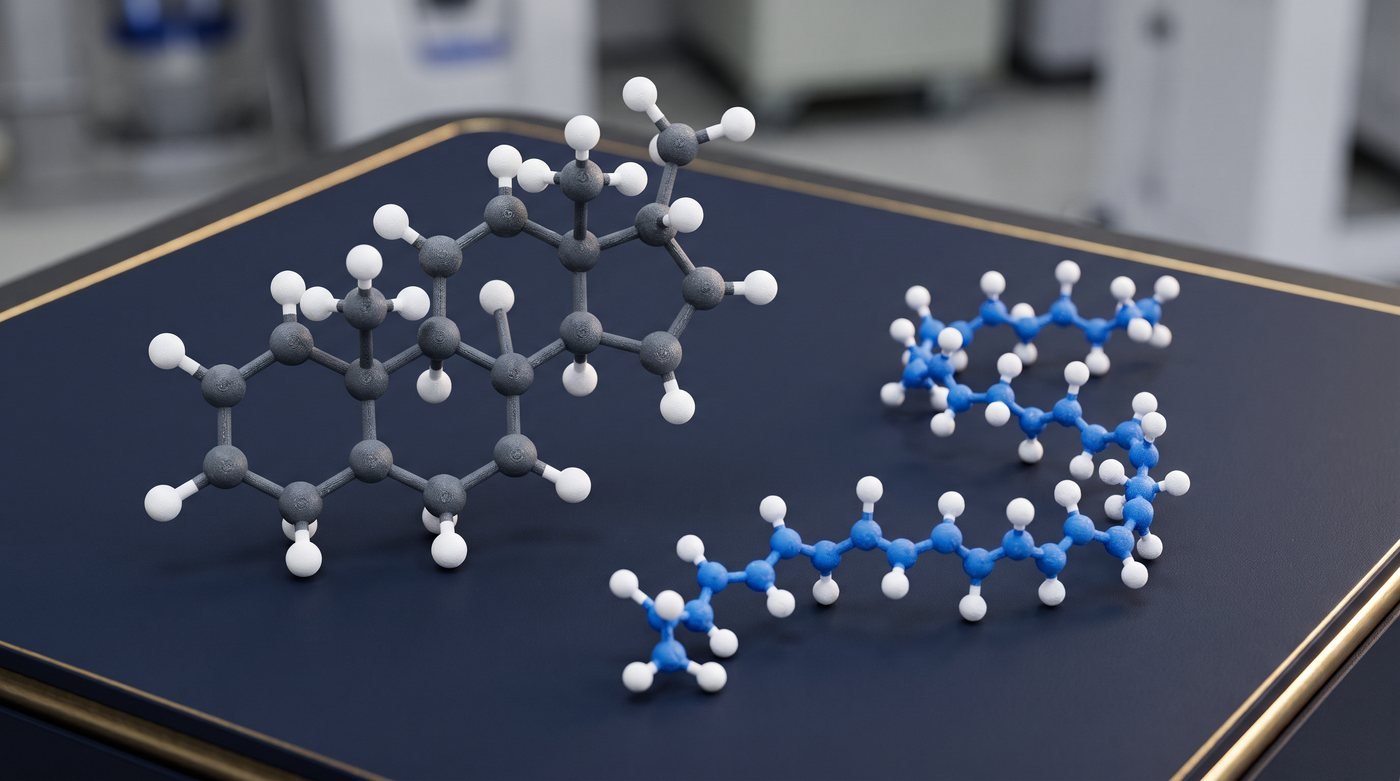
"Are peptides steroids?" is one of the most common questions people search when they first come across research peptides. The short answer is no. Peptides and steroids are two different classes of molecule: they are built from different raw materials, have different shapes and sizes, act on cells in different ways, and sit under different laws in Canada. This guide walks through the chemistry, the biology and the Canadian legal picture side by side.
The short answer
Peptides are not steroids. A peptide is a short chain of amino acids, the same building blocks that make up proteins. A steroid is a lipid built on a rigid four-ring carbon skeleton. The two are grouped together mostly because both show up in conversations about hormones and athletic performance, not because they share any chemistry.
- Different building blocks. Peptides are made of amino acids; steroids are made from cholesterol-derived carbon rings.
- Different places of action. Most peptides act on receptors on the surface of a cell. Most steroids pass into the cell and act on receptors that regulate genes.
- Different legal status. In Canada, anabolic steroids are a Schedule IV controlled substance. Research peptides are not listed in the Controlled Drugs and Substances Act.
What a peptide is
A peptide is a chain of amino acids linked end to end by peptide bonds. The order of the amino acids (the sequence) defines the molecule. Chains of up to about 50 amino acids are usually called peptides; longer chains that fold into complex three-dimensional shapes are usually called proteins. For a fuller introduction, see our beginner's guide to peptides.
Because they are built from amino acids, most peptides dissolve readily in water and are too large and too polar to slip through a cell membrane. They typically work by binding a receptor on the outside of the cell, often a G protein-coupled receptor, which then relays a signal inward. The body makes many peptides of its own, including insulin, glucagon and the incretin hormone GLP-1.
How research peptides are made
Research peptides are built in the laboratory by solid-phase peptide synthesis, a method introduced by Bruce Merrifield in 1963. The chain is assembled one amino acid at a time on a resin bead, cleaved off, purified and then checked by HPLC and mass spectrometry. More than 80 peptide drugs have reached the market worldwide, which is one reason peptides are such an active research area.
What a steroid is
A steroid is a lipid, not a chain of amino acids. Every steroid shares the same core: four fused carbon rings (three six-membered rings and one five-membered ring) with 17 carbon atoms in the skeleton. Different side groups on that core produce cholesterol, cortisol, estradiol, testosterone and many others. The body makes its steroid hormones from cholesterol.
Steroids are small and fat-soluble, so they pass easily through cell membranes. Most steroid hormones bind receptors inside the cell, known as nuclear receptors. The hormone-receptor complex then attaches to DNA and switches particular genes on or off. That is a fundamentally different mechanism from a peptide binding a receptor on the cell surface.
Anabolic steroids and corticosteroids
When people say "steroids" in a sports or bodybuilding context, they usually mean anabolic-androgenic steroids: synthetic compounds derived from testosterone, such as nandrolone or stanozolol. Corticosteroids, such as the cortisone in some prescription creams, are a separate group within the same chemical family and act on different receptors.
Peptides vs. steroids at a glance
| Property | Peptides | Steroids |
|---|---|---|
| Building blocks | Amino acids joined by peptide bonds | Four fused carbon rings derived from cholesterol |
| Typical size | About 2 to 50 amino acids (roughly 200 to 6,000 daltons) | Small and compact (roughly 250 to 450 daltons) |
| Solubility | Mostly water-soluble | Fat-soluble (lipophilic) |
| Main site of action | Receptors on the cell surface | Receptors inside the cell that regulate genes |
| Laboratory production | Solid-phase peptide synthesis | Organic synthesis that modifies a steroid core |
| Quality testing | HPLC purity and mass spectrometry identity | Chromatography and spectroscopy |
| Canadian legal status | Food and Drugs Act; not a controlled substance | Anabolic steroids: Schedule IV, Controlled Drugs and Substances Act |
Size ranges are typical values for illustration; individual molecules vary.
Peptide hormones vs. steroid hormones
Part of the confusion comes from the word "hormone." Endocrinology sorts hormones into classes by their chemistry, and peptides and steroids are two of the main ones. A hormone can be a peptide or a steroid, but not both.
| Peptide (or protein) hormones | Steroid hormones |
|---|---|
| Insulin | Cortisol |
| Glucagon | Testosterone |
| Growth hormone | Estradiol |
| GLP-1 | Aldosterone |
Another source of confusion is that some research peptides are studied for their effects on other hormone systems. Growth hormone secretagogues such as ipamorelin and the GHRH analogs are peptides studied for how they signal the pituitary gland; they contain no steroid structure at all. Our overview of peptides studied on the growth hormone axis covers that group in detail.
How Canadian law treats each one
In Canada, anabolic steroids and their derivatives are listed in Schedule IV of the Controlled Drugs and Substances Act. Testosterone, nandrolone, methyltestosterone, oxandrolone and stanozolol are among the substances named, which places them in the same legal framework as other controlled drugs.
Research peptides are not listed in the Controlled Drugs and Substances Act. They fall under the Food and Drugs Act, where a substance is regulated according to how it is represented and sold. Some peptides are approved prescription medicines; the research versions sold by suppliers like 94 Supreme Peptides are sold strictly for laboratory research and labelled "not for human consumption."
- Anabolic steroids. Controlled substances under Schedule IV of the CDSA.
- Research peptides. Regulated under the Food and Drugs Act according to how they are represented and sold; not controlled substances.
- Labelling. Research-use-only labels describe a specific legal position. Our guide to what research-use-only labels mean explains it.
This section is a factual summary, not legal advice. See our article on peptides and the law in Canada for more detail.
Peptides, steroids and anti-doping rules
Sport is the one area where the two are handled together. The World Anti-Doping Agency's Prohibited List bans anabolic agents (section S1) and also bans many peptide hormones, growth factors and related substances (section S2). They appear in separate sections because they are different classes of molecule, but both are prohibited in competition.
Frequently asked questions
Are peptides steroids?
No. Peptides are chains of amino acids; steroids are lipids built on a four-ring carbon skeleton. They differ in structure, size, solubility, mechanism and legal status.
What is the difference between anabolic steroids and peptides?
Anabolic steroids are synthetic derivatives of testosterone that act on the androgen receptor inside cells. Peptides are amino-acid chains that mostly act on receptors on the cell surface. In Canada, anabolic steroids are Schedule IV controlled substances; research peptides are not.
Is a peptide a hormone?
Some are. Insulin, glucagon and growth hormone are peptide or protein hormones. Many other peptides are not hormones at all; they include structural fragments, signalling molecules and synthetic research compounds.
Are peptides banned in sport?
Many are. The WADA Prohibited List bans numerous peptide hormones and growth factors under section S2, separately from anabolic agents under section S1.
How can I check what is in a research peptide vial?
Look for a batch certificate of analysis showing HPLC purity and mass spectrometry identity. Our guide to reading a COA explains each line.
Sources
- Muttenthaler M, et al. Trends in peptide drug discovery. Nat Rev Drug Discov (2021)
- Bain DL, et al. Nuclear receptor structure: implications for function. Annu Rev Physiol (2007)
- Merrifield RB. Solid phase peptide synthesis. J Am Chem Soc (1963)
- Controlled Drugs and Substances Act, Schedule IV
- World Anti-Doping Agency, Prohibited List
Shop HPLC-tested research peptides
Third-party tested. Shipped from Canada. Built for researchers.
Shop peptides View COAsResearch use only. Educational content, not medical advice.
Key facts
| Also known as | NNC 26-0161, Aib-His-D-2-Nal-D-Phe-Lys-NH2 |
|---|---|
| Type | Synthetic pentapeptide growth hormone secretagogue (ghrelin receptor agonist) |
| CAS number | 170851-70-4 |
| Molecular formula | C38H49N9O5 |
| Molecular weight | 711.9 g/mol |
| Testing | HPLC, certificate of analysis per batch |