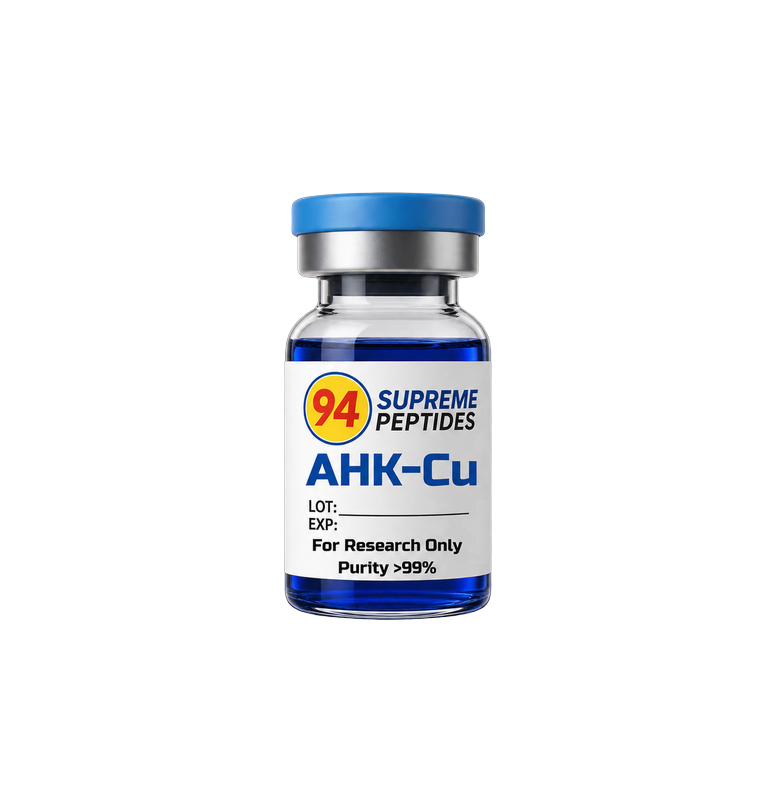
AHK-Cu
Research use only.
AHK-Cu is a small copper-carrying peptide studied mainly for hair and skin. Copper peptides like this one are popular in cosmetic and repair research.
What it is studied for
- Hair: its effect on hair follicles, thickness and growth.
- Skin: firmness and appearance in cosmetic research.
- Repair: blood flow and tissue health in research models.
What is AHK-Cu?
AHK-Cu is a synthetic copper peptide made of alanine, histidine and lysine bound to a copper(II) ion. It is a close analogue of GHK-Cu. In laboratory research it has mainly been studied for hair follicle growth and dermal papilla cell survival. It is sold here for laboratory research use only, not for human use.
Ala-His-Lys (copper complex)
Questions researchers ask
What is AHK-Cu?
AHK-Cu is the tripeptide L-alanyl-L-histidyl-L-lysine complexed with a copper(II) ion. It is structurally similar to the natural copper peptide GHK-Cu, with alanine replacing glycine at the first position. It is made by peptide synthesis and supplied as a lyophilized powder for laboratory research.
What is the difference between GHK-Cu and AHK-Cu?
GHK-Cu occurs naturally in human plasma and is widely studied for collagen, skin remodelling and wound repair. AHK-Cu is a synthetic analogue with alanine in place of glycine. Its published research focuses mostly on hair, especially follicle elongation and dermal papilla cells, with far fewer studies overall.
What is AHK-Cu studied for?
A 2007 study from Seoul National University found that AHK-Cu stimulated elongation of human hair follicles in culture and the growth of dermal papilla cells, the cells that regulate hair growth. It also shifted markers of cell death, such as Bcl-2/Bax and caspase-3, toward cell survival in vitro.
Why is AHK-Cu blue?
Like GHK-Cu, AHK-Cu holds a copper(II) ion bound to the peptide's nitrogen atoms. Copper(II) peptide complexes absorb orange-red light, so the powder and reconstituted solution look blue. The colour is expected and indicates copper is bound to the peptide, not that the material is degraded.
Is AHK-Cu legal in Canada?
In Canada, AHK-Cu is sold as a research chemical for laboratory use only. It is not authorized by Health Canada as a drug for human use, so it cannot be sold for human consumption. This is general information, not legal advice; researchers should confirm the rules that apply to them.
Published research 1 peer-reviewed paper
Chemical data verified against a public reference database.
Reviewed by the 94 Supreme Peptides team · For laboratory research use only. Not for human or veterinary use.
Guides about AHK-Cu
Related products
Customer reviews
Be the first to review this research peptide and help other researchers.
All products are sold strictly for laboratory and research use only — not for human or veterinary use, consumption, or therapeutic application. By purchasing you confirm you are a qualified researcher and accept full responsibility for safe handling and compliance with applicable laws.