

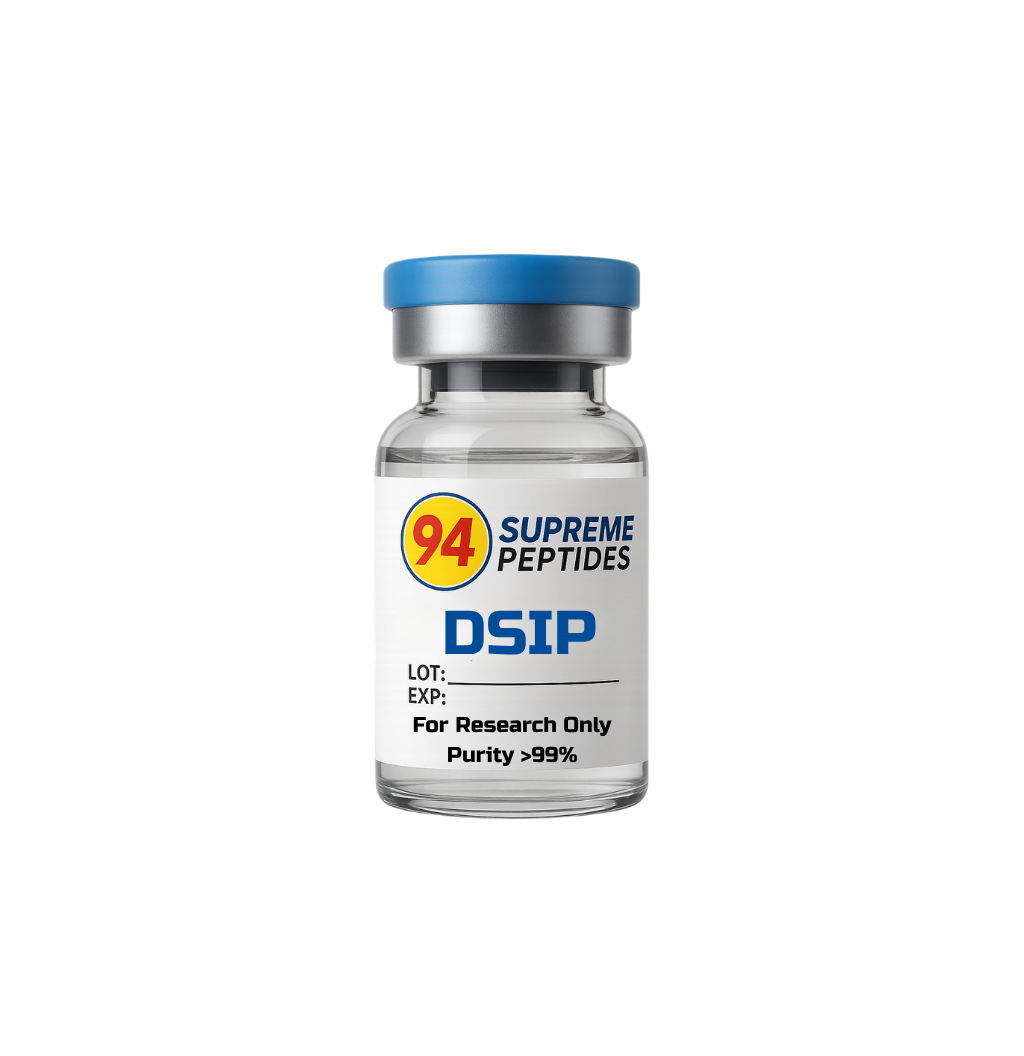
DSIP
Research use only.
DSIP (Delta Sleep-Inducing Peptide) is a naturally occurring peptide first linked to deep, slow-wave sleep. Researchers are interested in how it may influence rest, stress and the body's daily rhythms.
What it is studied for
- Sleep quality: its possible role in slow-wave sleep.
- Stress response: how it may affect stress hormones.
- Comfort and recovery: early work on pain and general balance.
What is DSIP (Delta Sleep-Inducing Peptide)?
DSIP, or delta sleep-inducing peptide, is a nine-amino-acid peptide (Trp-Ala-Gly-Gly-Asp-Ala-Ser-Gly-Glu) first isolated in 1977 from the blood of sleeping rabbits. It is studied in animal models for links to slow-wave sleep, stress hormones and circadian rhythm. Its gene and receptor have never been identified. It is sold here for laboratory research only.
Trp-Ala-Gly-Gly-Asp-Ala-Ser-Gly-GluQuestions researchers ask
What is DSIP?
DSIP is a nonapeptide isolated in 1977 by a Swiss research group from the cerebral venous blood of rabbits kept in induced sleep. Its name reflects early observations of increased delta (slow-wave) sleep in animals. Its structure does not resemble any other known peptide family, and its natural source in the body remains unresolved.
What is DSIP studied for in research?
Early animal work focused on slow-wave sleep. Later studies examined effects on stress and glucocorticoid responses, circadian rhythm, body temperature, neurotransmitter systems and pain thresholds in animal models. A 2006 review in the Journal of Neurochemistry described the link between DSIP and sleep as still poorly documented, so findings should be read cautiously.
How does DSIP work?
No one knows for certain. No DSIP gene, precursor protein or dedicated receptor has been identified, which is why researchers call it an unresolved riddle. One hypothesis is that DSIP mimics a related, still unidentified endogenous peptide responsible for the DSIP-like immunoreactivity found in hypothalamic neurosecretory nuclei of many vertebrates.
Is DSIP legal in Canada?
In Canada, DSIP is sold as a research chemical for laboratory use. It is not authorized by Health Canada as a drug for human use, so it cannot be sold for human consumption. It has an international nonproprietary name, emideltide, but no approved drug product contains it in Canada or the United States.
How should DSIP be stored?
Store the sealed, lyophilized vial cold and protected from light, refrigerated for short periods or frozen for longer storage. Once reconstituted with bacteriostatic water, keep the solution refrigerated. DSIP is a small, flexible peptide that degrades in biological fluids, so limiting temperature swings and freeze-thaw cycles helps preserve sample integrity.
Published research 2 peer-reviewed papers
Chemical data verified against a public reference database.
Reviewed by the 94 Supreme Peptides team · For laboratory research use only. Not for human or veterinary use.
Guides about DSIP
Related products
Customer reviews
Be the first to review this research peptide and help other researchers.
All products are sold strictly for laboratory and research use only — not for human or veterinary use, consumption, or therapeutic application. By purchasing you confirm you are a qualified researcher and accept full responsibility for safe handling and compliance with applicable laws.