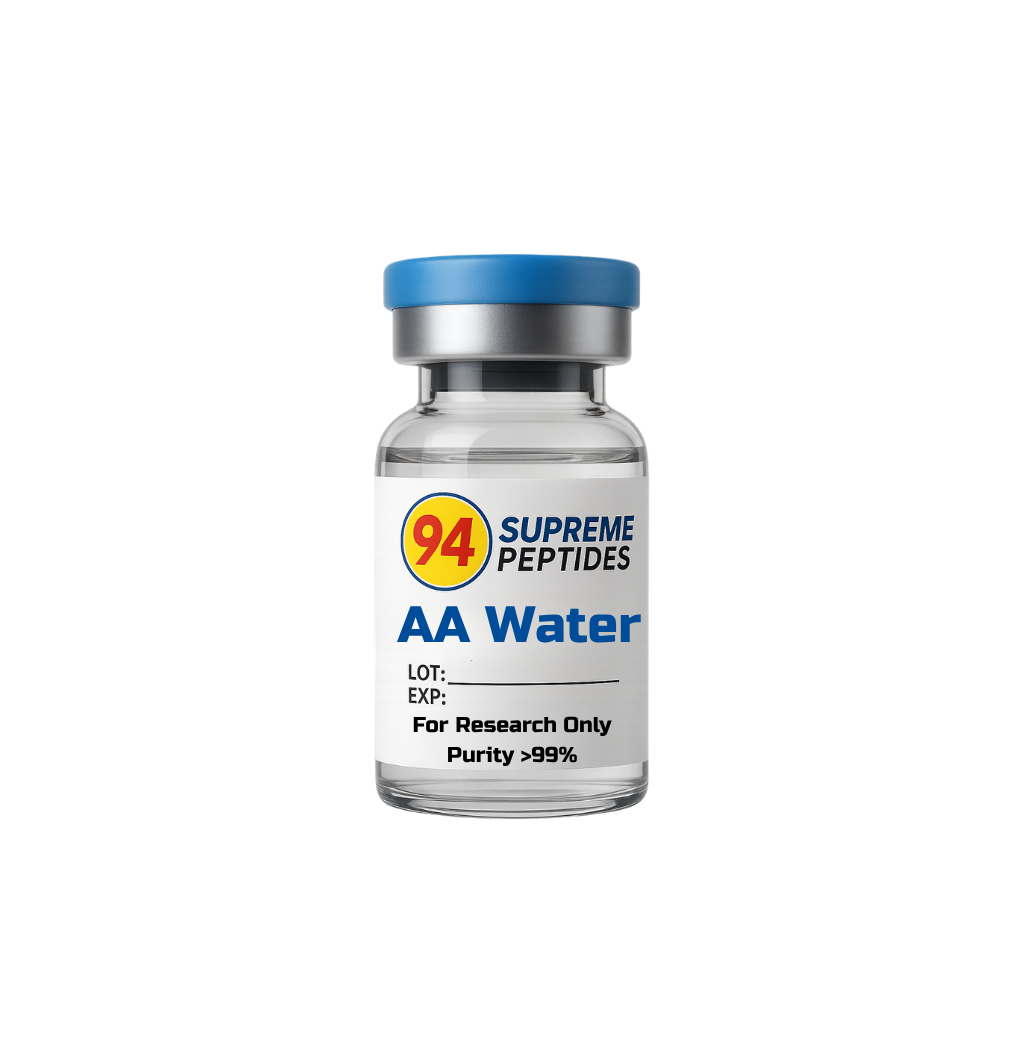
AA Water
Research use only.
AA Water (acetic acid water) is sterile water with a small amount of acetic acid added, making it mildly acidic. It is a reconstitution supply used for peptides that do not fully dissolve in ordinary bacteriostatic water.
What it is used for
- Tricky peptides: some peptides are sticky and dissolve better in a mildly acidic liquid.
- Clear mixing: helps a cloudy or clumpy mix turn clear.
- Lab handling: an alternative to bacteriostatic water when needed.
Good to know
Add it gently and swirl rather than shake. It is used when a peptide will not go fully into solution with bacteriostatic water alone. This is a laboratory supply provided for research handling only.
What is AA Water (Acetic Acid Water)?
Acetic acid water (AA water) is sterile water with a small amount of acetic acid added, making it mildly acidic. In the lab it is used as a reconstitution diluent for research peptides that do not dissolve fully or tend to clump in neutral water or bacteriostatic water. It is sold for laboratory research use only.
Questions researchers ask
Why use acetic acid water for peptides?
Some peptides, especially those rich in basic or hydrophobic amino acids, dissolve poorly or aggregate at neutral pH. Lowering the pH gives basic residues a positive charge, which increases repulsion between molecules and improves solubility. A mildly acidic diluent such as acetic acid water can help such peptides dissolve completely.
What is the difference between acetic acid water and bacteriostatic water?
Bacteriostatic water is neutral sterile water with benzyl alcohol added as a preservative for multiple draws. Acetic acid water is mildly acidic and is chosen to improve solubility rather than for preservation. Researchers usually start with bacteriostatic water and switch to acetic acid water only when a peptide will not dissolve.
When is acetic acid water used instead of bacteriostatic water?
It is used when a peptide's documentation recommends an acidic diluent, or when a peptide stays cloudy, forms particles or does not fully dissolve in bacteriostatic water. Adding the liquid slowly down the vial wall and swirling gently, rather than shaking, also reduces foaming and aggregation during reconstitution.
Is acetic acid water the same as vinegar?
No. Vinegar contains acetic acid but is not sterile, and it also contains other compounds from fermentation at a much higher, variable concentration. Acetic acid water is prepared as a sterile, dilute solution in purified water specifically for laboratory reconstitution, so vinegar should never be used as a substitute.
How should acetic acid water be stored?
Store sealed vials at room temperature, away from heat and direct light. Once opened, check the label: unless it states that a preservative is present, handle it like sterile water and avoid keeping an opened vial for long periods. Discard any vial that looks cloudy or contains particles.
Reviewed by the 94 Supreme Peptides team · For laboratory research use only. Not for human or veterinary use.
Related products
Customer reviews
Be the first to review this research peptide and help other researchers.
All products are sold strictly for laboratory and research use only — not for human or veterinary use, consumption, or therapeutic application. By purchasing you confirm you are a qualified researcher and accept full responsibility for safe handling and compliance with applicable laws.