

Collagen Peptides vs Research Peptides: What's the Difference?
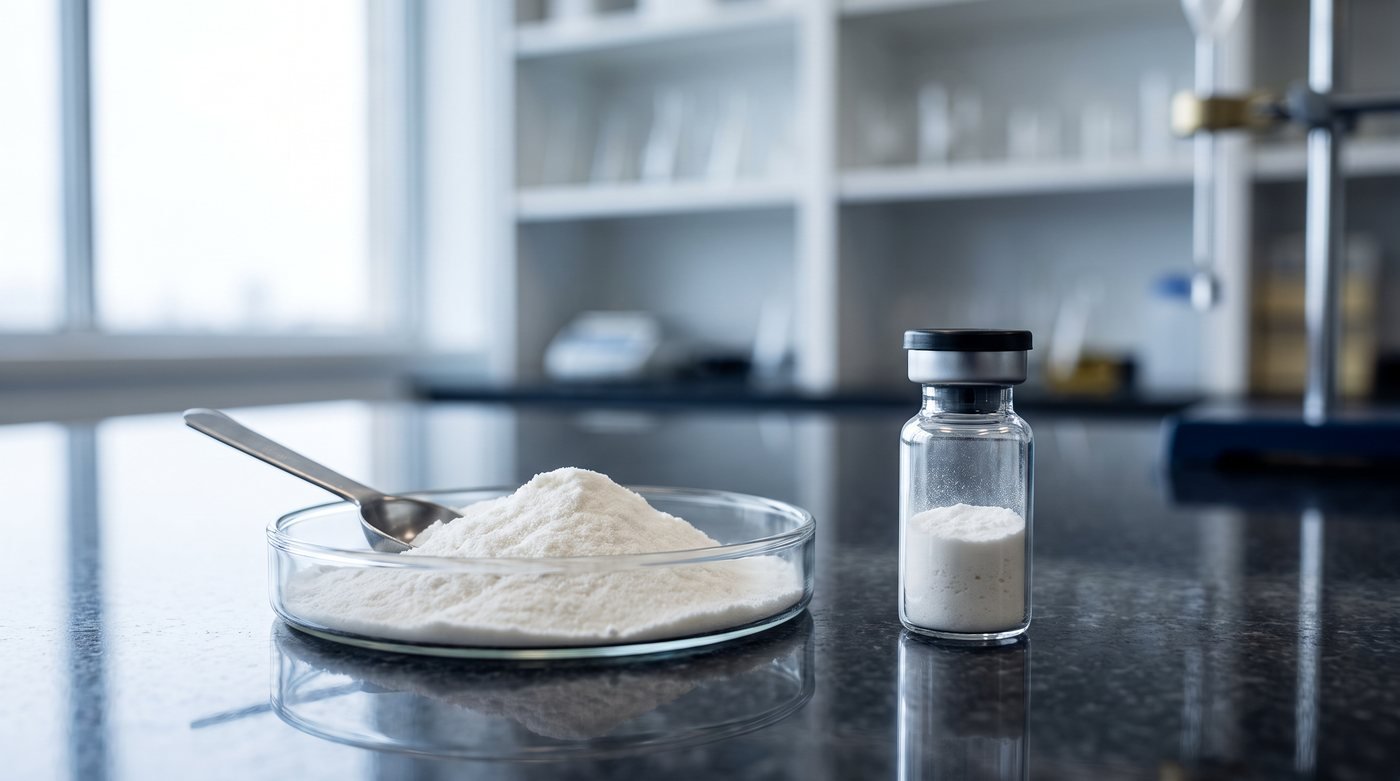
The word "peptides" now appears on two very different kinds of product. One is the tub of collagen peptides on a grocery or pharmacy shelf. The other is a research peptide: a single, defined molecule supplied as a freeze-dried powder for laboratory work. They share a name because both are made of amino acids, but almost everything else is different, from how they are made to what is in the container and how Canada regulates them. This guide sets the two side by side.
Collagen peptides vs. research peptides at a glance
| Property | Collagen peptides | Research peptides |
|---|---|---|
| Origin | Animal collagen from bovine, porcine, chicken or fish tissue | Built synthetically in a laboratory |
| What is in the container | A mixture of many different peptide fragments | One defined amino-acid sequence |
| Size | Mostly about 3 to 6 kilodaltons, varying by batch | A single exact molecular weight |
| How it is made | Enzymatic digestion of collagen | Solid-phase peptide synthesis |
| Quality described by | Protein content, source species, molecular weight range | HPLC purity and mass spectrometry identity |
| Form | Bulk powder measured in grams | Lyophilized powder in a sealed vial, measured in milligrams |
| Canadian category | Food or natural health product | Research chemical, not for human consumption |
What collagen peptides are
Collagen is the most abundant structural protein in animal tissue. Its chains are built from a repeating pattern of glycine followed by two other amino acids, very often proline and hydroxyproline, and three chains twist together into a rope-like triple helix. Glycine makes up about a third of collagen's amino acids.
How collagen peptides are made
- Collagen-rich tissue (hide, bone, skin or scales) is cleaned and treated.
- The collagen is heated to separate the three chains, which produces gelatin.
- Enzymes such as alcalase, papain or pepsin cut the chains into smaller fragments.
- The digest is filtered, concentrated and dried into a powder sold as hydrolyzed collagen or "collagen peptides."
Because it is a digest, collagen peptide powder is not one molecule. Two batches from different suppliers, or from different source animals, can contain different mixtures of fragments. Studies of these products have looked at which small fragments survive digestion; a 2005 study, for example, detected collagen-derived dipeptides such as prolyl-hydroxyproline (Pro-Hyp) in blood samples after gelatin hydrolysate was consumed.
What research peptides are
A research peptide is a specific chain of amino acids with a known sequence, built from scratch rather than cut out of an animal protein. Laboratories make them by solid-phase peptide synthesis, attaching one amino acid at a time to a resin bead until the full sequence is assembled, then cleaving the finished chain off and purifying it. The method was introduced by Bruce Merrifield in 1963 and is still the basis of peptide manufacturing.
The purified peptide is freeze-dried into a stable powder, which is why it arrives as a small cake in a sealed vial; see what lyophilization is. In the laboratory it is reconstituted with bacteriostatic water before measurement.
How quality is measured
Because the two products are so different, their quality is described in different terms.
- Collagen peptides. Labels describe the source animal, the protein content and sometimes an average molecular weight. There is no single "purity" figure, because the product is a mixture by design.
- Research peptides. High-performance liquid chromatography (HPLC) shows what percentage of the material is the intended peptide, and mass spectrometry confirms that its molecular weight matches the expected sequence. Both results appear on a certificate of analysis for each batch.
Our guide on how peptide purity is verified explains the numbers on a research peptide COA.
How Canada classifies each one
In Canada, collagen peptide powders are generally sold as foods or as natural health products. Health Canada's Natural Health Products Ingredients Database lists hydrolyzed collagen as an ingredient, with source materials that include bovine, porcine, chicken and fish tissue.
Research peptides are a different regulatory category. They are sold for laboratory research only, are not approved for human or veterinary use, and are labelled accordingly. Our article on what research-use-only labels mean covers the legal position.
This section is a factual summary, not legal advice.
Where collagen and research peptides meet
The two worlds overlap in one area of study: collagen itself. Some research peptides are studied precisely for how they influence collagen in laboratory models.
- GHK-Cu. The copper complex of the tripeptide glycyl-histidyl-lysine, examined for its effects on collagen, elastin and glycosaminoglycan synthesis.
- AHK-Cu. A related copper tripeptide studied in skin and hair-follicle models.
These are single synthetic molecules of a few hundred daltons, not collagen fragments, and they are studied for signalling effects rather than as a source of protein. Our guide to peptides in skin research covers this group.
How to tell which one you are looking at
- Check the format. A bulk powder measured in grams is almost always collagen; a sealed vial measured in milligrams is a research peptide.
- Check the name. Collagen labels name an animal source; research peptides name a specific sequence and often a CAS number.
- Check the quality claim. Protein content points to collagen; an HPLC purity percentage with a batch COA points to a research peptide.
- Check the label category. Food or natural health product versus "research use only."
Frequently asked questions
Are collagen peptides the same as research peptides?
No. Collagen peptides are a mixture of fragments digested from animal collagen. Research peptides are single, synthetic molecules with one defined sequence, sold for laboratory research.
What is hydrolyzed collagen?
Hydrolyzed collagen is collagen that has been heated and broken down with enzymes into smaller fragments, mostly in the 3 to 6 kilodalton range. It is the product sold as "collagen peptides."
Is GHK-Cu a collagen peptide?
No. GHK-Cu is a single synthetic tripeptide bound to copper. It is studied for how it influences collagen synthesis in laboratory models, but it is not a collagen fragment or a collagen supplement.
Why do research peptides come in vials?
Research peptides are freeze-dried (lyophilized) into a stable powder and sealed in a vial to protect them from moisture and oxidation until they are reconstituted in the laboratory.
How are research peptides tested?
By HPLC for purity and by mass spectrometry for identity, with results reported on a batch certificate of analysis. Every product in our store lists its current COA.
Sources
- León-López A, et al. Hydrolyzed collagen: sources and applications. Molecules (2019)
- Iwai K, et al. Identification of food-derived collagen peptides in human blood after oral ingestion of gelatin hydrolysates. J Agric Food Chem (2005)
- Health Canada, Natural Health Products Ingredients Database: Hydrolyzed collagen
- Merrifield RB. Solid phase peptide synthesis. J Am Chem Soc (1963)
- Pickart L, Margolina A. Regenerative and protective actions of the GHK-Cu peptide. Int J Mol Sci (2018)
Shop HPLC-tested research peptides
Third-party tested. Shipped from Canada. Built for researchers.
Shop GHK-Cu View COAsResearch use only. Educational content, not medical advice.
Key facts
| Also known as | BAC water, Bacteriostatic water (USP) |
|---|---|
| Type | Sterile water containing benzyl alcohol as a bacteriostatic preservative (laboratory diluent) |
| Testing | HPLC, certificate of analysis per batch |
Sources
- Effects of benzyl alcohol on aggregation of recombinant human interleukin-1-receptor antagonist in reconstituted lyophilized formulations (2005)
- Regenerative and Protective Actions of the GHK-Cu Peptide in the Light of the New Gene Data (2018)
- GHK Peptide as a Natural Modulator of Multiple Cellular Pathways in Skin Regeneration (2015)
- The effect of tripeptide-copper complex on human hair growth in vitro (2007)