

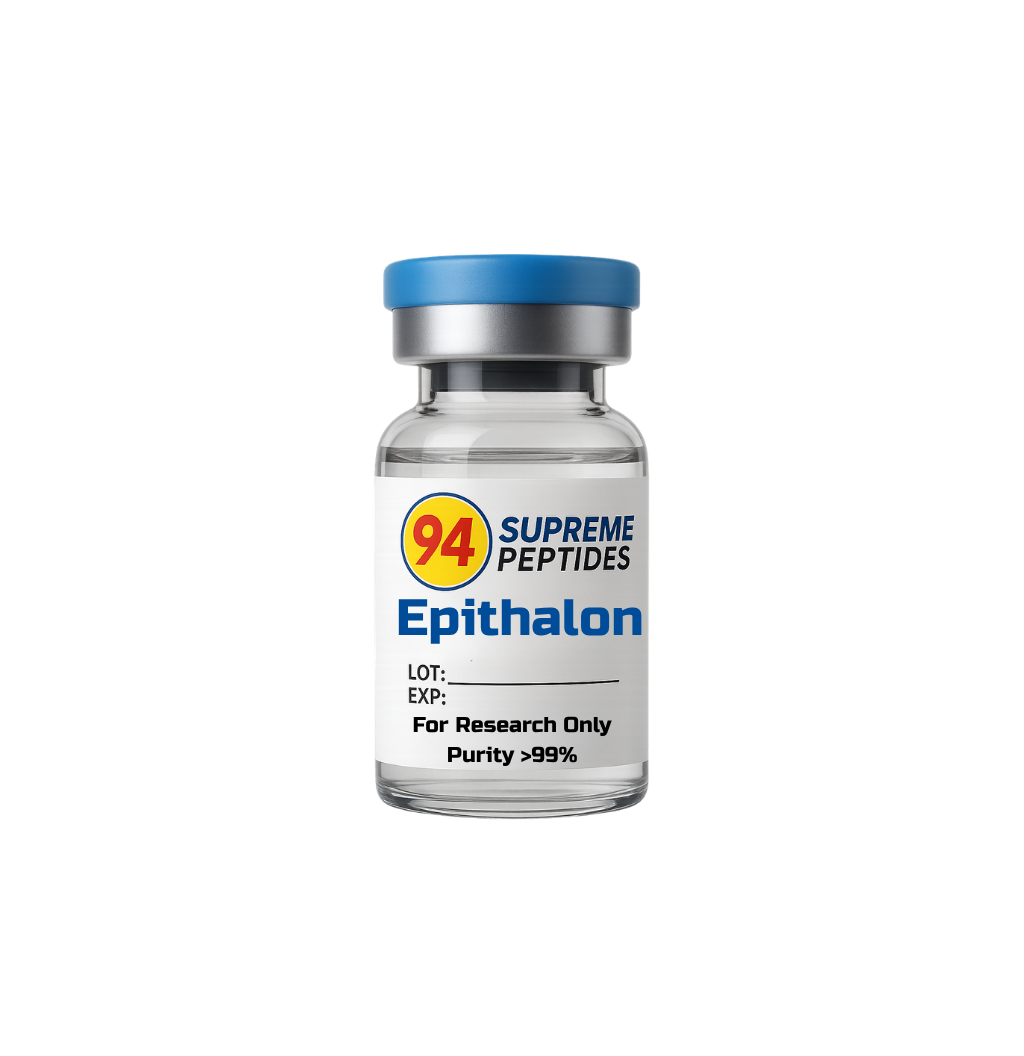
Epithalon
Research use only.
Epithalon is a short peptide based on a natural substance made by the pineal gland. It is one of the most studied longevity research peptides, looked at for its effects on ageing and the body's internal clock.
What it is studied for
- Healthy ageing: effects on telomeres, the protective caps on our DNA.
- Sleep and rhythm: effects on the day-night cycle in research models.
- Antioxidant support: markers of oxidative stress in cell studies.
What is Epithalon (Epitalon)?
Epithalon, also spelled Epitalon, is a synthetic four-amino-acid peptide (Ala-Glu-Asp-Gly) designed from the composition of epithalamin, a bovine pineal gland extract. It is studied in cell and animal models for effects on telomerase activity, melatonin production and age-related changes. It is sold here strictly for laboratory research use only.
Ala-Glu-Asp-GlyQuestions researchers ask
Epitalon vs Epithalon: are they the same?
Yes. Epitalon, Epithalon and Epithalone are spelling variants for the same tetrapeptide, Ala-Glu-Asp-Gly (AEDG). The differences come from transliteration of the original Russian name. PubChem lists all three under one compound record with the same formula, C14H22N4O9. Epithalamin, by contrast, is the pineal gland extract it was modelled on.
Is Epitalon a peptide?
Yes. Epitalon is a tetrapeptide, a chain of four amino acids (alanine, glutamic acid, aspartic acid and glycine) joined by peptide bonds. It is made by chemical synthesis rather than extracted from tissue, which allows a defined sequence and purity that can be checked by HPLC and mass spectrometry.
What is Epitalon studied for?
Research has focused on ageing biology. Cell studies report telomerase activation and telomere elongation in human somatic cell lines, and animal work has examined melatonin synthesis, circadian rhythm, antioxidant enzymes and lifespan in rodents. A 2025 review in the International Journal of Molecular Sciences notes the full mechanism remains uncertain.
Epitalon vs Pinealon: what is the difference?
Both are short synthetic bioregulator peptides developed by the same St. Petersburg research group. Epitalon is a tetrapeptide (Ala-Glu-Asp-Gly) tied to pineal gland and telomerase research. Pinealon is a tripeptide (Glu-Asp-Arg) studied mainly for protecting brain cells from oxidative stress. They have different sequences and are not interchangeable.
How should Epitalon be stored?
Store lyophilized Epitalon at about -20 °C and protected from light for long-term stability. After reconstitution with bacteriostatic water, keep the solution refrigerated at 2 to 8 °C. Avoid repeated freeze-thaw cycles and record the reconstitution date on each vial for laboratory tracking.
Published research 2 peer-reviewed papers
Chemical data verified against a public reference database.
Reviewed by the 94 Supreme Peptides team · For laboratory research use only. Not for human or veterinary use.
About Epithalon
Epithalon (also spelled Epitalon) is a synthetic tetrapeptide, Ala-Glu-Asp-Gly, developed from epithalamin, a pineal-gland extract. It is one of the best-known bioregulator peptides and is studied mainly for telomerase activity, pineal/melatonin function and circadian rhythm in ageing research.
Key research areas
- Telomerase & telomeres — Telomerase activation and telomere length in cell models.
- Pineal function — Melatonin synthesis and pineal-gland research.
- Circadian rhythm — Day–night regulation in ageing models.
- Bioregulator research — Part of the Khavinson short-peptide research family.
Specifications
| Compound class | Synthetic tetrapeptide bioregulator (AEDG) |
| Form | Lyophilized powder |
| Sizes | 10mg |
| Purity | ≥99% (HPLC), per-batch COA |
| Storage | Lyophilized: store at −20 °C, protected from light. After reconstitution: 2–8 °C. |
Frequently asked questions
Is it Epithalon or Epitalon?
Both spellings refer to the same tetrapeptide, Ala-Glu-Asp-Gly.
What is Epithalon studied for?
Telomerase activity, pineal and melatonin function, and circadian rhythm in ageing research.
How is it related to Thymalin and Pinealon?
All three are bioregulator peptides from the same research lineage, each studied for a different system.
Is Epithalon for human use?
No. It is sold strictly for laboratory research use only.
Related research compounds
For laboratory research use only. Not for human or veterinary consumption.
Guides about Epithalon
Related products
Customer reviews
Be the first to review this research peptide and help other researchers.
All products are sold strictly for laboratory and research use only — not for human or veterinary use, consumption, or therapeutic application. By purchasing you confirm you are a qualified researcher and accept full responsibility for safe handling and compliance with applicable laws.