

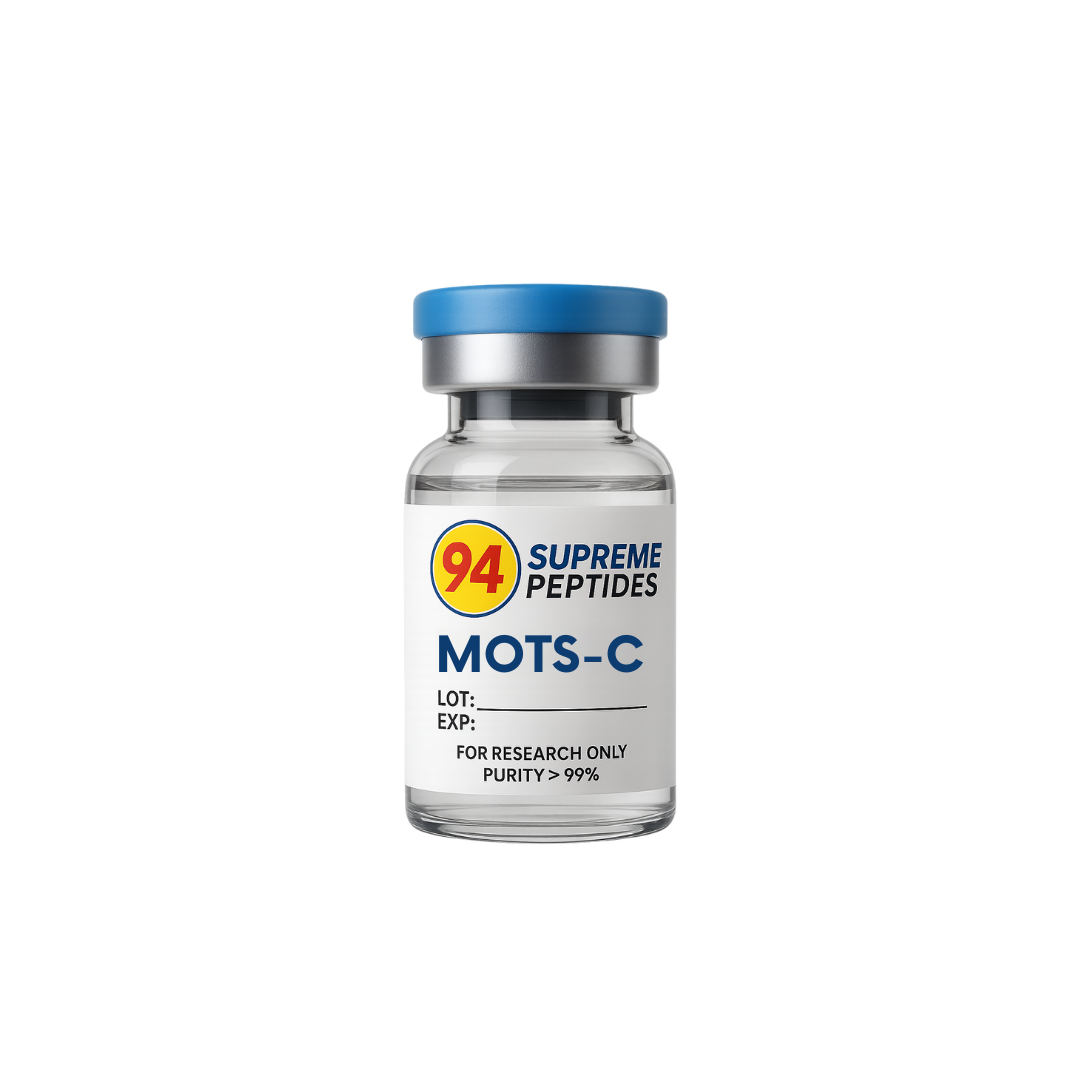
MOTS-C
Research use only.
MOTS-c is a peptide that comes from the mitochondria, the energy centres of our cells. It is studied for how it may influence metabolism and stamina.
What it is studied for
- Metabolism: how the body handles blood sugar and fat.
- Endurance: its effect on physical stamina in research models.
- Healthy ageing: cell energy over time in research models.
What is MOTS-c?
MOTS-c is a 16-amino-acid peptide encoded within mitochondrial DNA, in the 12S rRNA gene. It was first described in 2015 as a mitochondrial signalling peptide. Researchers study it for its role in metabolic regulation, including AMPK activation, glucose handling in skeletal muscle and insulin sensitivity in cell and mouse models.
Met-Arg-Trp-Gln-Glu-Met-Gly-Tyr-Ile-Phe-Tyr-Pro-Arg-Lys-Leu-ArgQuestions researchers ask
What does MOTS-c stand for?
MOTS-c stands for Mitochondrial Open reading frame of the Twelve S rRNA type-c. The name describes where it is encoded: a short open reading frame inside the mitochondrial 12S ribosomal RNA gene. It belongs to a small family of mitochondrial-derived peptides that also includes humanin and the SHLP peptides.
How does MOTS-c work?
In the original 2015 mouse and cell studies, MOTS-c acted mainly on skeletal muscle. It inhibited the folate cycle and linked de novo purine synthesis, which led to activation of AMPK, a key cellular energy sensor. Later work showed it can move to the nucleus during metabolic stress and influence nuclear gene expression.
MOTS-c vs NAD+: what is the difference?
MOTS-c is a 16-amino-acid signalling peptide encoded by mitochondrial DNA. NAD+ is not a peptide; it is a coenzyme that carries electrons in redox reactions and fuels enzymes such as sirtuins and PARPs. Both are studied in metabolism and ageing research, but they act through entirely different mechanisms and chemical classes.
Is MOTS-c legal in Canada?
In Canada, MOTS-c is sold as a research chemical for laboratory use. It is not authorized by Health Canada as a drug for human use, so it cannot be sold for human consumption. It has no approved medical product anywhere. This is general information about its status, not legal advice.
Does MOTS-c need to be refrigerated?
Lyophilized MOTS-c is best stored cold, dry and protected from light, typically at about -20 °C for long-term storage. Once reconstituted for laboratory work, the solution should be kept refrigerated at 2 to 8 °C and repeated freeze-thaw cycles avoided, since they can degrade peptides. Check the batch COA for handling notes.
Published research 3 peer-reviewed papers
Chemical data verified against a public reference database.
Reviewed by the 94 Supreme Peptides team · For laboratory research use only. Not for human or veterinary use.
About MOTS-C
MOTS-c is a 16-amino-acid peptide encoded within the mitochondrial genome, in the 12S rRNA region, rather than in the cell nucleus. First described in 2015, it is one of the best-studied "mitochondrial-derived peptides" and is researched for its role in cellular energy sensing and metabolic signalling, mostly in cell and rodent models.
Key research areas
- Metabolic signalling — AMPK activation and how cells sense and use energy.
- Insulin-sensitivity models — Glucose handling in skeletal muscle in rodent studies.
- Exercise and muscle research — MOTS-c levels rise with exercise; studied in physical-capacity models.
- Ageing research — Age-related changes in mitochondrial-derived peptides and metabolism.
Specifications
| Sequence | MRWQEMGYIFYPRKLR (16 amino acids) |
| Molecular formula | C101H152N28O22S2 |
| Molecular weight | approx. 2174.6 g/mol |
| Origin | Mitochondrial genome (12S rRNA region) |
| Form | Lyophilized powder |
| Purity | HPLC-tested, per-batch certificate of analysis |
Frequently asked questions
What is MOTS-c?
A 16-amino-acid peptide encoded by mitochondrial DNA, studied in metabolic-signalling, insulin-sensitivity and exercise research models.
Why is it called a mitochondrial-derived peptide?
Most proteins are encoded in the cell nucleus. MOTS-c is encoded in the small genome inside mitochondria, which is why it is grouped with other mitochondrial-derived peptides such as humanin.
Does it come with a COA?
Every batch is HPLC-tested. The certificate for each size is linked on this page and listed in the COA library.
Is MOTS-c for human use?
No. It is sold strictly for laboratory research use only.
Related research compounds
For laboratory research use only. Not for human or veterinary consumption.
Guides about MOTS-C
Related products

Customer reviews
Be the first to review this research peptide and help other researchers.
All products are sold strictly for laboratory and research use only — not for human or veterinary use, consumption, or therapeutic application. By purchasing you confirm you are a qualified researcher and accept full responsibility for safe handling and compliance with applicable laws.