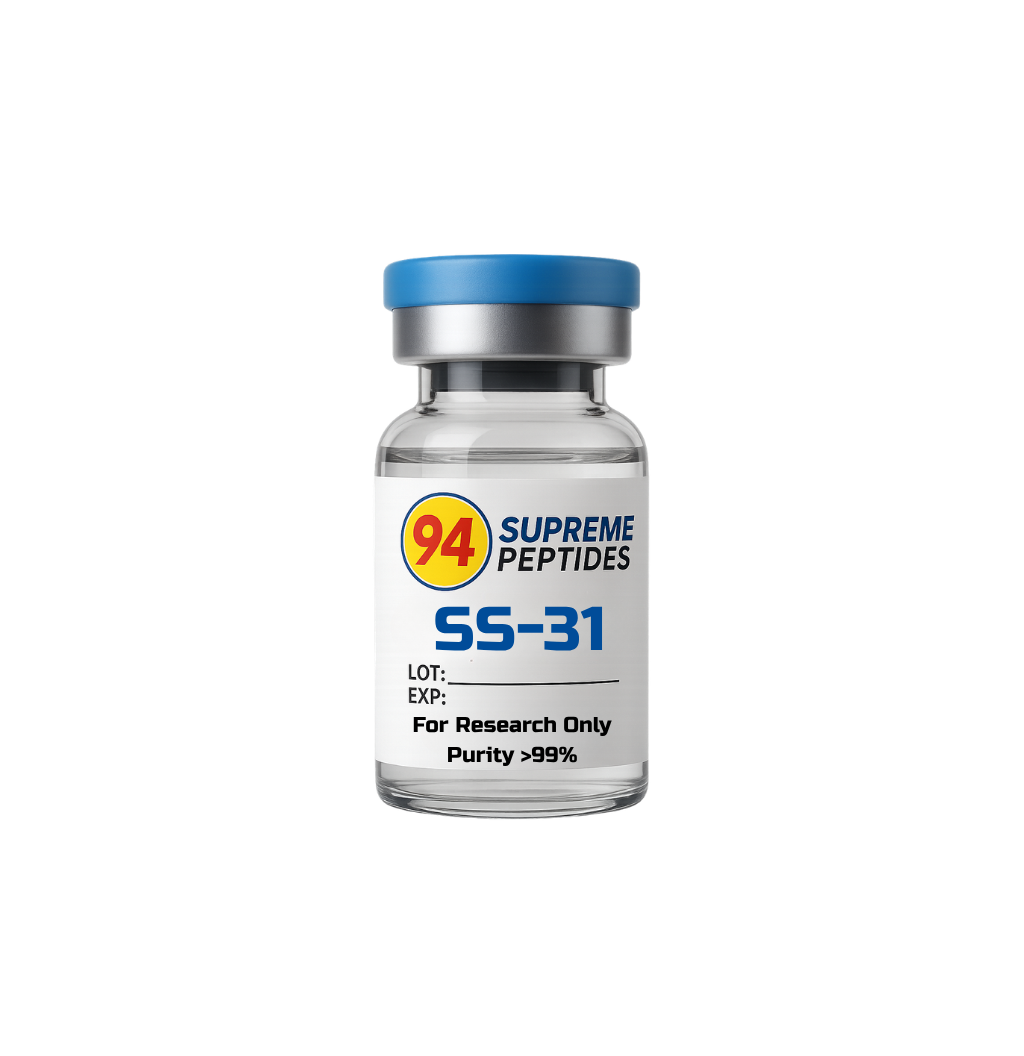
SS-31
Research use only.
SS-31 is a peptide that targets the mitochondria, the tiny power plants inside our cells. Researchers study it for how it may protect and support energy production in tissues that work hard, like the heart and muscles.
What it is studied for
- Cell energy: mitochondrial function in research models.
- Heart and muscle: protection in research models of stress and fatigue.
- Healthy ageing: its role in age-related energy decline.
What is SS-31 (Elamipretide)?
SS-31 is a synthetic four-amino-acid peptide (D-Arg-Dmt-Lys-Phe-NH2) that concentrates in the inner mitochondrial membrane and binds cardiolipin. Its drug name is elamipretide. It is studied in cell and animal models of mitochondrial dysfunction, ageing, heart and kidney injury. The research-grade compound sold here is for laboratory use only.
D-Arg-Dmt-Lys-Phe-NH2 (Dmt = 2',6'-dimethyltyrosine)
Questions researchers ask
Is SS-31 elamipretide?
Yes. SS-31 is the original research code for elamipretide, named after its developers Hazel Szeto and Peter Schiller. It has also been called MTP-131 and Bendavia. All of these names refer to the same tetrapeptide, D-Arg-Dmt-Lys-Phe-NH2, with CAS number 736992-21-5 and formula C32H49N9O5.
Is elamipretide FDA approved?
Yes, for one indication. On September 19, 2025, the FDA granted accelerated approval to Forzinity (elamipretide) injection to improve muscle strength in patients with Barth syndrome weighing at least 30 kg. It is not approved by Health Canada. Research-grade SS-31 is not a drug product and is for laboratory use only.
How does SS-31 work?
SS-31 crosses cell membranes and accumulates in the inner mitochondrial membrane, where it binds cardiolipin through electrostatic and hydrophobic interactions. In experimental models this helps keep cytochrome c working as an electron carrier rather than a peroxidase, supporting electron transport and ATP production while reducing reactive oxygen species.
What is SS-31 studied for in research?
SS-31 is studied in models where mitochondrial dysfunction plays a role: ischaemia-reperfusion injury of the heart and kidney, heart failure, skeletal muscle ageing, neurodegeneration and eye disease. Clinical development has included Barth syndrome, primary mitochondrial myopathy and dry age-related macular degeneration.
How should SS-31 be stored?
Store the sealed, lyophilized vial refrigerated for short periods or frozen for longer storage, away from light. After reconstitution with bacteriostatic water, keep the solution refrigerated and avoid repeated freeze-thaw cycles. Label each vial with the batch number and reconstitution date for laboratory records.
Published research 3 peer-reviewed papers
Chemical data verified against a public reference database.
Reviewed by the 94 Supreme Peptides team · For laboratory research use only. Not for human or veterinary use.
Guides about SS-31
Related products
Customer reviews
Be the first to review this research peptide and help other researchers.
All products are sold strictly for laboratory and research use only — not for human or veterinary use, consumption, or therapeutic application. By purchasing you confirm you are a qualified researcher and accept full responsibility for safe handling and compliance with applicable laws.