

AHK-Cu vs GHK-Cu: Comparing the Two Copper Research Peptides
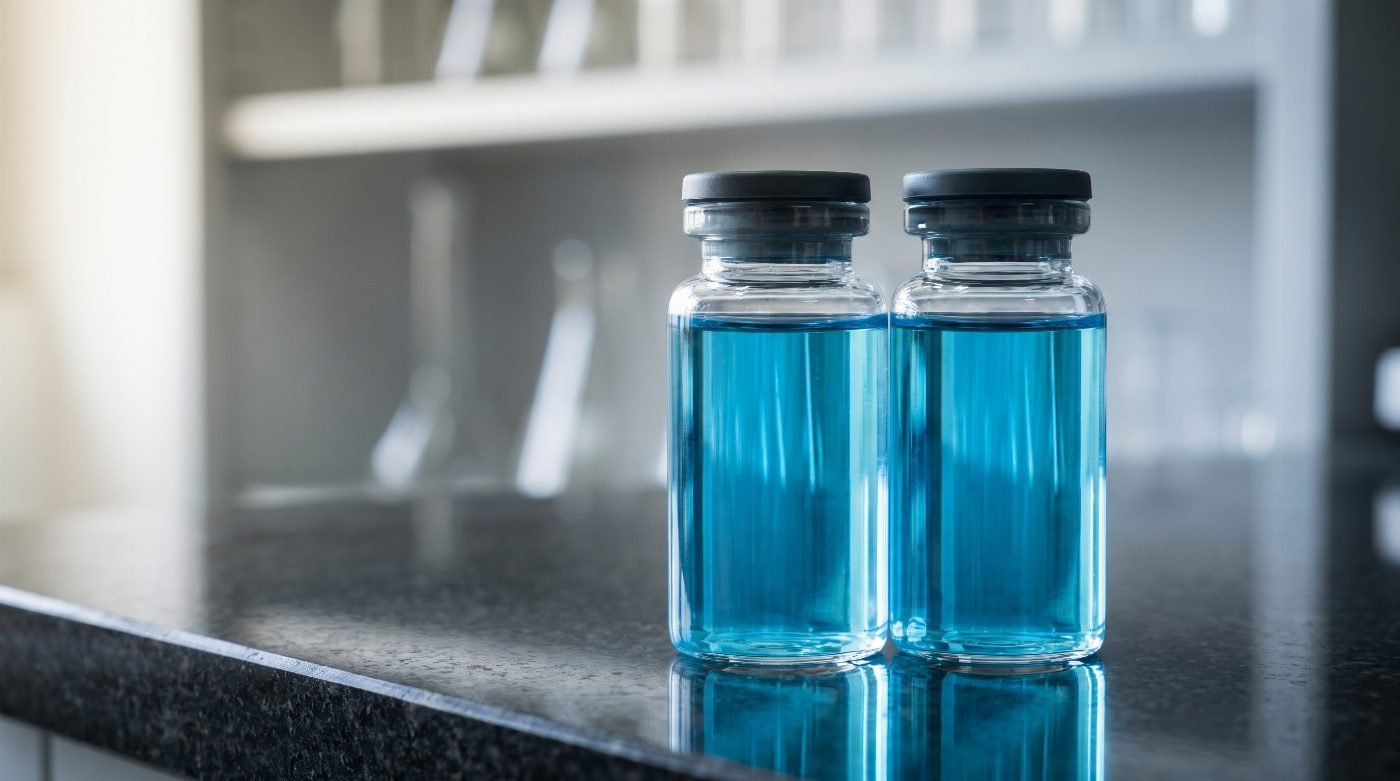
AHK-Cu and GHK-Cu are the two best-known copper peptides, and they get mixed up constantly. Both are small copper-bound peptides studied in skin and tissue research — but the literature points them at different questions. This guide covers what each one is, what researchers actually study them for, and how they compare. Framed for research context only.
What are copper peptides?
Copper peptides are short amino-acid chains that bind a copper ion. In solution they take on a characteristic blue colour. The two most-studied are GHK-Cu and AHK-Cu — closely related molecules that differ by a single amino acid, which is exactly why they are so easy to confuse. Both are used as research compounds and, in cosmetic-science literature, are studied in topical and in-vitro models rather than as approved medicines.
GHK-Cu: the skin-research peptide
GHK-Cu is the copper complex of the tripeptide glycyl-L-histidyl-L-lysine (GHK). It is the more heavily studied of the two, with a large body of cosmetic-science and cell-culture work. Researchers have investigated GHK-Cu in models of skin remodelling, collagen and extracellular-matrix production, and wound-healing biology. It is the copper peptide most often referenced when people talk about "skin" applications in a research setting.
AHK-Cu: the hair-research peptide
AHK-Cu is the copper complex of alanyl-L-histidyl-L-lysine (AHK) — the same His-Lys backbone with alanine in place of glycine. In the literature it turns up most often in hair-related research: dermal papilla cells, follicle models, and studies exploring hair-growth pathways in vitro. That hair-versus-skin emphasis is the practical difference researchers point to, even though the molecules are structurally very close.
Both remain research compounds. The findings below are from preclinical and cosmetic-science models, not outcomes promised for people.
GHK-Cu vs AHK-Cu, side by side
| Attribute | GHK-Cu | AHK-Cu |
|---|---|---|
| Peptide | Glycyl-L-histidyl-L-lysine + copper | Alanyl-L-histidyl-L-lysine + copper |
| Difference | Glycine at position 1 | Alanine at position 1 |
| Primary research focus | Skin, collagen, matrix, wound models | Hair follicle / dermal papilla models |
| Colour in solution | Blue | Blue |
| Typical study models | In-vitro / cosmetic science | In-vitro / cosmetic science |
| Form | Lyophilized; reconstituted | Lyophilized; reconstituted |
The honest summary: same His-Lys copper chemistry, one different residue, and a literature that leans skin for GHK-Cu and hair for AHK-Cu. Anyone presenting either as a finished cosmetic result is going beyond what the research supports.
How to verify purity: COA & HPLC
Copper peptides are only as useful as their purity. Here is how researchers confirm what is in the vial.
Every 94 Supreme batch ships with its own COA
Third-party tested to HPLC ≥99%, per batch. See the certificates before you order.
Frequently asked questions
What is the difference between AHK-Cu and GHK-Cu?
One amino acid. GHK-Cu uses glycine at the first position; AHK-Cu uses alanine. In the literature GHK-Cu is studied more for skin/collagen models and AHK-Cu more for hair/follicle models.
Why are copper peptides blue?
The peptide binds a copper(II) ion, which gives the solution its characteristic blue colour once reconstituted.
Are these approved skincare ingredients?
They are sold and studied as research compounds. Nothing here is a cosmetic or medical claim; the research is largely in-vitro and cosmetic-science models.
Why does purity matter for copper peptides?
Impurities and incorrect copper binding are variables. A per-batch HPLC figure on a COA confirms what is actually in the vial.
Research copper peptides, tested and shipped from Canada
HPLC ≥99%, a COA for every batch, and 1–3 day Xpress Post across Canada.
References
- Pickart L, Margolina A. (2018). Regenerative and Protective Actions of the GHK-Cu Peptide. International Journal of Molecular Sciences. PubMed
- Pickart L. (2008). The human tri-peptide GHK and tissue remodeling. Journal of Biomaterials Science. PubMed
- Copper peptides in hair-follicle research (AHK-Cu). PubMed search. PubMed
Citations point to PubMed so you can read the primary sources directly.
For research use only. Not for human or veterinary consumption. This article is educational and summarizes cosmetic-science and preclinical research; it is not medical or cosmetic advice. Products are sold strictly as research chemicals.