

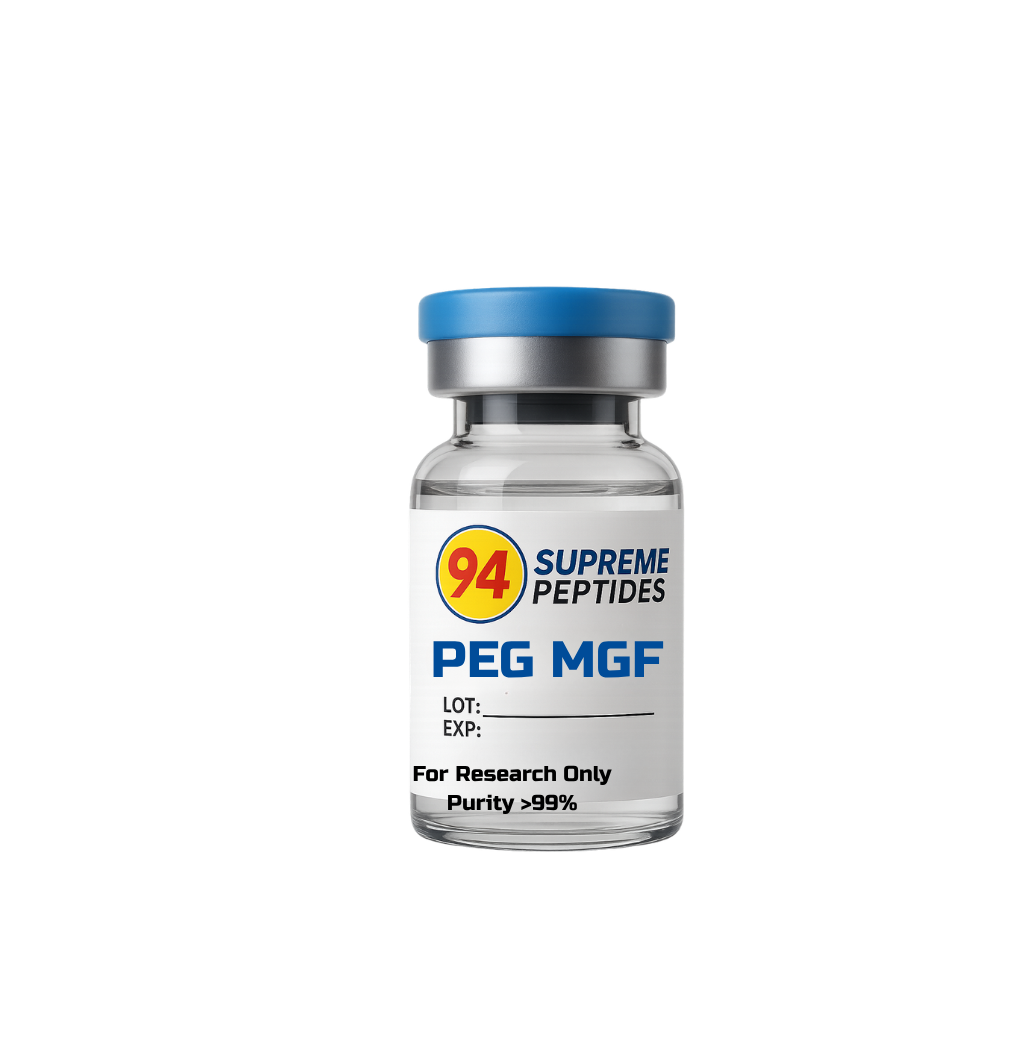
PEG MGF
Research use only.
PEG-MGF is a lab-made, longer-lasting version of Mechano Growth Factor, a natural signal the body releases when muscle is worked hard. The PEG coating helps it last longer in research settings.
What it is studied for
- Muscle repair: its effect on muscle-repair (satellite) cells.
- Recovery: its effect after exercise or strain in research models.
- Growth: new muscle cell formation in research models.
What is PEG-MGF?
PEG-MGF is a synthetic version of mechano growth factor (MGF), a peptide based on the unique E-domain of an IGF-1 splice variant (IGF-1Ec in humans) that is expressed in muscle after mechanical loading. A polyethylene glycol (PEG) chain is attached to slow its breakdown in research settings. It is supplied for laboratory research only.
MGF E-domain peptide (C-terminal residues of the IGF-1Ec/Eb splice variant) attached to a polyethylene glycol chain
Questions researchers ask
What is mechano growth factor (MGF)?
MGF is the name given to a splice variant of the IGF-1 gene (IGF-1Ec in humans, IGF-1Eb in rodents) that is up-regulated in muscle after mechanical stress. Synthetic MGF peptides correspond to the variant's unique C-terminal E-domain. A 2010 Endocrinology review notes that a natural MGF peptide has not yet been isolated from tissues.
What does PEG mean in PEG-MGF?
PEG stands for polyethylene glycol. Pegylation means attaching PEG chains to a peptide or protein, which increases its size and shields it from enzymes and rapid clearance. For MGF, which is short-lived in its native form, pegylation is intended to extend its stability and duration in laboratory research settings.
How does MGF differ from IGF-1?
MGF shares the IGF-1 gene but its E-domain acts differently from mature IGF-1. In a cell study (Yang and Goldspink, 2002), the MGF E-domain increased myoblast proliferation and inhibited terminal differentiation, and blocking the IGF-1 receptor did not stop this, suggesting a separate receptor. Mature IGF-1 instead promoted differentiation.
Is PEG-MGF legal in Canada?
In Canada, PEG-MGF is sold as a research chemical for laboratory use. It is not authorized by Health Canada as a drug for human use, so it cannot be sold for human consumption. Material from 94 Supreme Peptides is supplied for laboratory research only, with a per-batch COA, and is not for human or veterinary use.
How should PEG-MGF be stored?
Lyophilized PEG-MGF is typically kept at -20 °C, dry and protected from light. After reconstitution, labs usually store the solution at 2-8 °C, protect it from light and avoid repeated freeze-thaw cycles, often by aliquoting. No peer-reviewed study sets a single shelf life, so follow your lab's stability protocol.
Published research 3 peer-reviewed papers
Reviewed by the 94 Supreme Peptides team · For laboratory research use only. Not for human or veterinary use.
Related products
Customer reviews
Be the first to review this research peptide and help other researchers.
All products are sold strictly for laboratory and research use only — not for human or veterinary use, consumption, or therapeutic application. By purchasing you confirm you are a qualified researcher and accept full responsibility for safe handling and compliance with applicable laws.