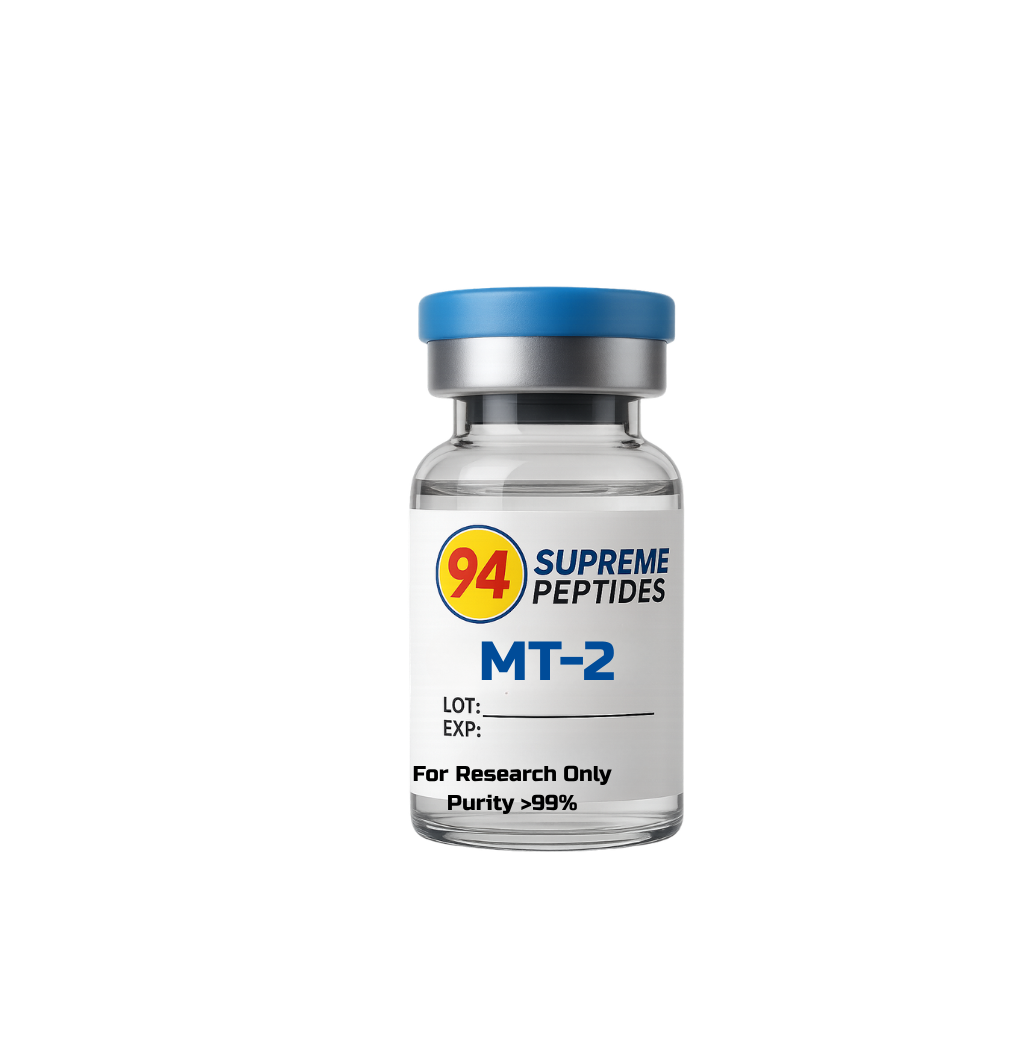
MT-2 (Melanotan 2)
Research use only.
Melanotan 2 (MT-2) is a lab-made peptide that tells skin cells to produce more melanin, the pigment behind a tan. It is studied for tanning and, separately, for effects on appetite and libido.
What it is studied for
- Skin pigmentation: melanin production with less UV exposure in studies.
- Libido: effects on sexual desire in research models.
- Appetite: its effect on hunger.
What is MT-2 (Melanotan 2)?
Melanotan 2 (MT-2) is a synthetic cyclic peptide of seven amino acids modelled on alpha-melanocyte-stimulating hormone. It binds several melanocortin receptors, including MC1R on pigment cells and MC3R and MC4R in the brain. It is studied in research on pigmentation and central melanocortin signalling. Sold strictly for laboratory research use.
Ac-Nle-cyclo[Asp-His-D-Phe-Arg-Trp-Lys]-NH2Questions researchers ask
What is the difference between Melanotan 1 and Melanotan 2?
Melanotan 1 (afamelanotide) is a linear 13-residue peptide that acts mainly at MC1R. Melanotan 2 is a shorter, cyclic seven-residue peptide that is more potent and less selective, also activating MC3R and MC4R. Afamelanotide became an approved medicine; Melanotan 2 has never been approved by any major regulator.
What is the difference between PT-141 and Melanotan 2?
PT-141 (bremelanotide) is derived from Melanotan 2 and shares its cyclic core. The key structural difference is the C-terminus: Melanotan 2 is an amide, PT-141 a free acid. Melanotan 2 research focused on pigmentation, while PT-141 was developed and approved in the US for its central effects on sexual desire.
How does Melanotan 2 work?
Melanotan 2 mimics alpha-MSH. At MC1R on melanocytes it activates cAMP signalling that increases eumelanin production. Because it also crosses into the brain and activates MC3R and MC4R, research has linked it to effects on appetite and sexual behaviour in animal models, which is why it is described as non-selective.
How should Melanotan 2 be stored?
Keep lyophilized Melanotan 2 sealed, cold and protected from light, refrigerated for short periods or frozen for long-term storage. After reconstitution in bacteriostatic water, store the solution at 2 to 8 °C and avoid repeated freeze-thaw cycles, which can degrade the peptide and affect the reliability of research results.
Published research 3 peer-reviewed papers
Chemical data verified against a public reference database.
Reviewed by the 94 Supreme Peptides team · For laboratory research use only. Not for human or veterinary use.
Related products
Customer reviews
Be the first to review this research peptide and help other researchers.
All products are sold strictly for laboratory and research use only — not for human or veterinary use, consumption, or therapeutic application. By purchasing you confirm you are a qualified researcher and accept full responsibility for safe handling and compliance with applicable laws.