

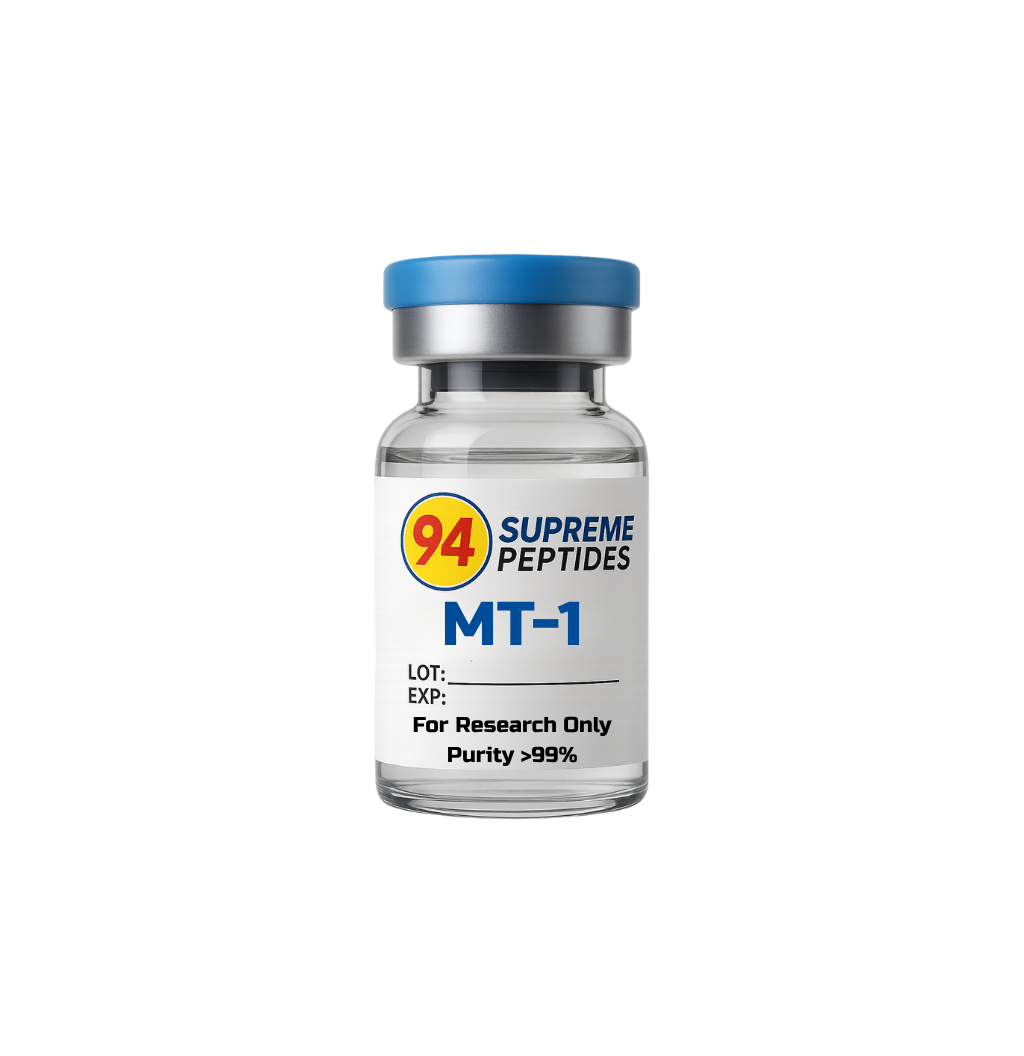
MT-1 (Melanotan 1)
Research use only.
Melanotan 1 (MT-1) is a lab-made version of a natural hormone that tells skin cells to produce more melanin, the pigment that gives skin its colour. It is studied mainly for tanning and skin protection from sunlight.
What it is studied for
- Skin pigmentation: melanin production with less UV exposure in studies.
- Sun sensitivity: research in light-sensitivity conditions.
What is MT-1 (Melanotan 1 / Afamelanotide)?
Melanotan 1 (MT-1), also known as afamelanotide, is a synthetic 13-amino-acid analogue of alpha-melanocyte-stimulating hormone. Two substitutions make it more stable and potent than the natural hormone. It activates the melanocortin 1 receptor on melanocytes and is studied in research on melanin production and photoprotection. Sold for laboratory research only.
Ac-Ser-Tyr-Ser-Nle-Glu-His-D-Phe-Arg-Trp-Gly-Lys-Pro-Val-NH2Questions researchers ask
What is afamelanotide?
Afamelanotide is the official drug name for Melanotan 1. It is the active ingredient in Scenesse, a prescription implant approved in Europe (2014), the United States (2019) and Canada (2026) for adults with erythropoietic protoporphyria. The research-grade peptide sold here is not that drug product and is for laboratory use only.
What is the difference between Melanotan 1 and Melanotan 2?
Melanotan 1 is a linear 13-residue peptide that acts fairly selectively at the MC1R pigmentation receptor. Melanotan 2 is a smaller seven-residue cyclic peptide that binds several melanocortin receptors, including MC3R and MC4R in the brain. Only Melanotan 1, as afamelanotide, progressed to regulatory approval as a medicine.
How does Melanotan 1 work?
Melanotan 1 mimics alpha-MSH, the natural hormone that binds the melanocortin 1 receptor (MC1R) on melanocytes. Receptor activation raises cAMP and shifts melanin synthesis toward darker eumelanin. In research models this pathway is studied for pigmentation and protection against UV-related damage, independent of direct sun exposure.
Who developed Melanotan 1?
Melanotan 1 was developed at the University of Arizona in the 1980s by researchers including Mac Hadley and Victor Hruby, who replaced methionine with norleucine and L-phenylalanine with D-phenylalanine in alpha-MSH. These changes made the peptide far more resistant to breakdown. Clinuvel later developed it as afamelanotide.
Published research 3 peer-reviewed papers
Chemical data verified against a public reference database.
Reviewed by the 94 Supreme Peptides team · For laboratory research use only. Not for human or veterinary use.
Related products
Customer reviews
Be the first to review this research peptide and help other researchers.
All products are sold strictly for laboratory and research use only — not for human or veterinary use, consumption, or therapeutic application. By purchasing you confirm you are a qualified researcher and accept full responsibility for safe handling and compliance with applicable laws.